


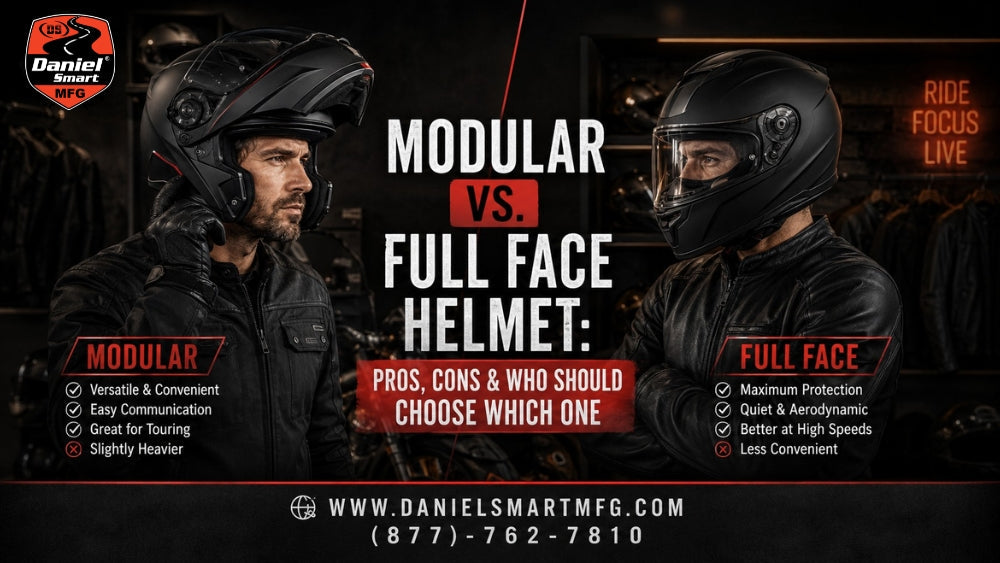
Every rider comes to the decision once in a lifetime about motorcycle helmets and has to choose between modular vs. full face helmets. If you are also wondering about it these days, you first need to understand that both types of helmets are made with different priorities. The wrong one for your riding style means you are at risk.
Previously, we explored the difference between half helmets and 3/4 helmets and compared DOT vs. non-certified helmets to help riders understand helmet coverage and safety standards.
Today, we’ll take that comparison a step further by discussing modular vs. full-face helmets. We’ll look at their key differences, pros and cons, protection levels, comfort, and practicality to help you determine which helmet is the better choice.
So, let's compare both and see motorcycle helmet coverage levels for each and which helmet is suitable for your riding style.
Modular vs. Full Face Helmet: What Do You Need to Know?
Here is a detailed brief on each to help you figure it out:
Full-face Helmets: The Safety Baseline
A full-face helmet is a one-piece molded shell. The chin bar is not a separate piece but part of the structure, so an impact load is spread over the whole helmet rather than concentrating at a joint.
Pros:
-
Provides comprehensive protection, including coverage for the head, chin, and jaw.
-
No latches or hinges to break down
-
Lighter and quieter than a comparable modular
-
The only type of helmet accepted for racing categories requiring SNELL or ECE 22.05/22.06 certification on track days. Also, it needs to be a DOT-certified motorcycle helmet.
Cons:
-
No stopping for a drink, a chat, or some fresh air
-
More confining, which some riders find bothersome on stop-and-go traffic or hot weather
Modular Helmets: Convenience with a Trade-off
A modular helmet allows the chin bar to swing up, making it more like an open face helmet at a stop. The whole idea is, you don't have to take the helmet off to talk to a petrol station attendant or grab a sandwich.
The trade-off is a mechanical one. The moving parts are a locking latch and hinge, and they are usually weaker than a fixed shell. However, they do offer convenience as you can flip up the entire part to talk, drink, or just enjoy the air.
Pros:
-
Chin bar flips up, doesn't remove helmet
-
Acts as a full-face helmet closed and semi-open at a stop
-
Popular for touring as it can handle long stretches of highway and quick breaks without a helmet change.
Cons:
-
Thicker than a full face, the hinge and latch hardware usually adds a noticeable amount of weight
-
More wind noise as the seam between chin bar and shell is harder to close tight
-
The chin bar is a known weak spot for high-energy impacts.
-
The hinge makes it more difficult to meet that testing standard, so you'll find fewer SNELL-rated models.
Are Modular Helmets Safer Than Full-face Helmets?
No, full-face helmets are still known as a safe choice. The major reason is that the one-piece design means there are no joints that could potentially fail.
But when we talk about modular helmets, they often fall short in offering chin safety during an impact.
However, it’s important to remember that being "safer on paper" doesn’t tell the whole story. If you wear a modular helmet correctly, fully locked, closed, and properly fitted, it can actually provide better protection than a loosely worn full-face helmet or a half-shell. So, you may need to understand how to wear it properly and ensure your helmet isn't loose when you are on the highway.
So, if the ease of a modular helmet encourages you to wear proper chin protection instead of opting for an open-face helmet just for comfort, that’s a significant safety improvement in real-world situations.
Which one is the Best Helmet for Long-Distance Touring?
For long-distance touring, modular helmets usually come out on top for a bunch of practical reasons. They’re great for toll booths, quick petrol stops, and those brief conversations at rest areas. Besides, during those long rides, being able to open the chin bar for some airflow is a real game-changer.
Look for a modular helmet that has a P/J-rated closure, which means it’s been tested and certified for both open and closed positions. And don’t forget to lock that chin bar before you get back up to highway speed; that’s the most common slip-up among modular riders!
However, if you’re planning on high-speed, high-mileage touring where crash protection is your main concern, a full-face helmet is still the better option.
Which is Better, a Modular or a Full-face Helmet?
There’s no definitive answer; it really depends on what fits your riding style best.
-
Pick a full-face helmet if you’re into sport bikes, commuting at highway speeds, tracking your bike, or if you want the highest level of protection without any compromises.
-
If you’re more of a long-distance tourer, ride with a passenger who needs to communicate, stop often, or want a helmet that works for both open and closed riding, then a modular helmet is your best bet.
-
And definitely skip the 3/4 and half-shell helmets if you’re riding above city speeds. They may meet the basic legal requirements in most states, but they leave your face and jaw completely unprotected.
Regardless of the helmet type you end up with, the certification and fit are what really count, not just the shape. A full-face helmet that doesn’t fit right can actually let you down more than a well-fitted modular one. So, prioritize your neck size and head shape first, and then consider the helmet type.
Conclusion
Choosing between a modular and full-face helmet ultimately depends on your riding style, comfort needs, and the level of protection you prioritize.
Full-face helmets offer comprehensive coverage, while modular helmets provide greater convenience for touring and frequent stops. Regardless of your choice, always prioritize proper fit and recognized safety certification.
Riders looking for quality motorcycle gear can also explore options from Daniel Smart MFG, a trusted name in motorcycle accessories and riding equipment.
While a 3/4 shell motorcycle helmet may offer greater freedom and ventilation, riders should understand its reduced facial and chin coverage before choosing it. The right helmet should balance protection, comfort, and practicality.
FAQs
3. Is a 3/4 shell motorcycle helmet safe for highway riding?
A 3/4 shell motorcycle helmet provides coverage around the top, sides, and back of the head but leaves the face and chin exposed. For highway or higher-speed riding, a full-face or properly certified modular helmet generally offers more comprehensive protection.
2. Are full-face helmets more comfortable than modular helmets?
Full-face helmets can feel lighter and more streamlined during rides. Modular helmets offer greater convenience, especially when stopping frequently or communicating with others.
3. What should I consider when choosing between modular and full-face helmets?
Consider your riding speed, distance, weather, and need for convenience. Always prioritize proper fit, reliable certification, and sufficient coverage for your riding conditions.