


Wrong helmet coverage in the summer heat can be genuinely dangerous for any rider. In the heat of July and August, the ride can quickly become sweaty, causing discomfort while you are on the road.
In our previous blogs, we explored the best cruiser motorcycle helmets and shared practical motorcycle helmet care tips to help riders choose the right gear and keep it in top condition. Today, we're focusing on another important topic: how to choose the right helmet coverage level, especially when riding in hot summer weather.
Heat exhaustion can set in and slow your reaction while also clouding your road sense. This is why you need a motorcycle helmet coverage level that can protect your head, giving you better sense on the road while maintaining the excitement and rush.
What "Helmet Coverage Level" Actually Means
Helmet coverage level isn’t a measure of how well the motorcycle helmet is constructed, but how much of your head and face the shell and liner cover.
Two DOT-certified helmets can have the same foam density and shell material and still offer very different coverage, because coverage is about geometry: how far down the sides, how far forward over the face, whether the jaw is enclosed.
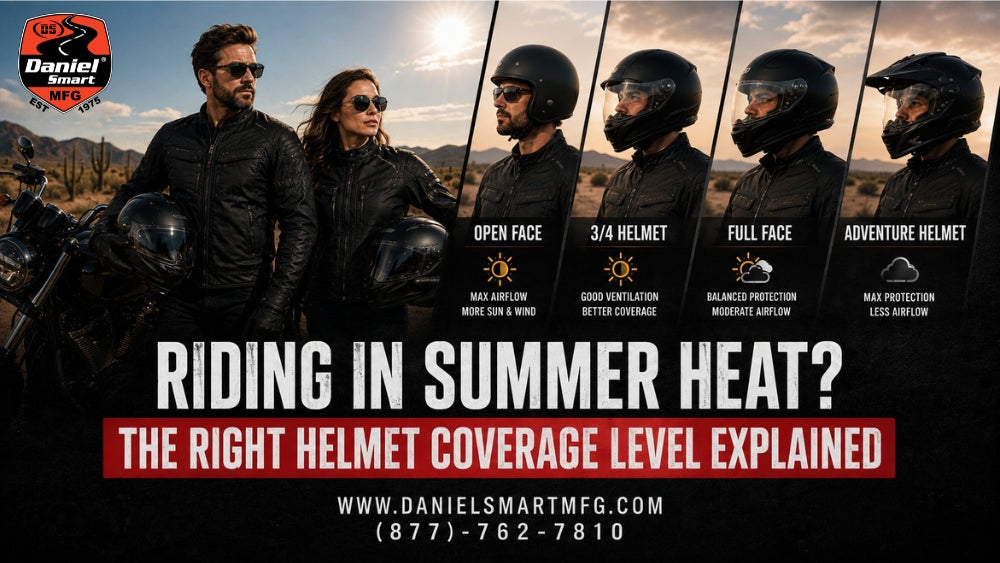
The U.S. market has four levels of coverage that are sold as summer motorcycle riding helmets:
They cover the whole head, with a fixed chin bar over the jaw. This is the highest level of cover, and the one that most crash injury data points to, because impacts to the face and chin are common in motorcycle crashes. The summer trade-off is heat retention around the face and jaw, although modern vent systems have closed that gap considerably.
This look (also called flip-up or flip-front) is like full-face helmets, but the chin bar pivots up. With the bar in the locked-down position, coverage is like a full-face helmet, but riders will often ride with it open at stoplights or in slow traffic to cut down heat buildup, worth noting since an open chin bar removes jaw protection when it’s up.
This helmet covers the top, back, and sides of your head. However, the face remains exposed or is protected only by the drop-down visor (no chin bar).
It does offer great airflow. But chin and face protection is poor, and when you are on a highway, there is wind, bugs, and grit just to your face. You can either add goggles or a lower face mask, or you need to change your helmet.
Often you will find them in the form of beanie or Micro DOT helmets. These helmets are designed to cover the crown of the skull and not much else.
Cruiser riders love this type of helmet as they are low-profile. But they offer almost no wind resistance. Micro DOT models do have a real DOT label and a real EPS liner, so they’re not the novelty “beanie” shells sold decades ago.
However, the coverage area is still the smallest of any street-legal helmet type. And they offer no protection at the jaw, face, or lower skull.
Full-face vs Open-face Helmet for Summer: Which One is Best for Summer?
While studying the NHTSA data, we get to know that the reported deaths of motorcyclists were around 6,228, or 16% fatalities, in 2024.
Now, the data doesn’t highlight anything about helmet coverage, but if you go deeper into these accidents, you will find more damage to the chin and face. So, we can say that poor helmet coverage is one of the reasons for such harsh impacts.
This is where a full-face or locked modular helmet really shines, offering protection that an open-face or half helmet simply can’t match.
If you are riding in summer, you need a ventilated helmet with features like:
-
Adjustable intake
-
Exhaust vents
-
Channeled internal airflow
-
A moisture-wicking liner.
After all, it’s the moving air that does most of the cooling, no matter how much coverage you have.
But there is a catch: when you're stuck in stop-and-go traffic, the difference becomes clear - a full-face helmet can really trap the heat.
However, an open-face or modular helmet with the visor up allows for better airflow.
If your summer rides mostly involve highway touring, a ventilated full-face helmet is a smart choice; it keeps you cool without sacrificing safety.
But if you're riding through city streets on a cruiser, a well-ventilated modular helmet or a 3/4 helmet paired with goggles strikes a nice balance.
Just keep in mind that a half helmet offers the least protection, no matter the weather.
Certification is Separate from Coverage: Check Both
The coverage level of the helmet tells all about the protection it offers to your face and chin. However, certification only shows how effective the claimed protection is.
In the U.S., the DOT (FMVSS 218) standard is the minimum requirement for riding on the roads.
This standard is based on manufacturers self-certifying their products. Know that the NHTSA only conducts random checks rather than requiring approval before they hit the market.
Meanwhile, the ECE 22.06 standard in Europe has introduced additional testing for rotational and oblique impacts at 45-degree angles. This one checks more points on the helmet shell than the previous standard.
As of January 1, 2026, ECE 22.06 will be mandatory for new helmet type approvals in Europe. This is why there is an increase in the number of helmets in the U.S. that carry both DOT and ECE 22.06 labels.
That said, none of this matters if the helmet doesn’t fit right. A certified helmet that’s too loose will perform poorly.
Keeping Any Helmet Livable in the Heat
Yes, focusing on the coverage level of the helmet along with the certification is important, but so is maintaining it.
Here are some tips to apply to ensure your helmets last longer:
-
After a sweaty ride, you must take out the liner and leave it to air instead of letting that moisture sit in the foam.
-
For cleaning the insides of a helmet, go for a mild soap solution rather than harsh chemicals. They can damage the EPS liner's glue and padding over time.
-
If you experience a hard impact, it’s time for a new helmet, regardless of how the outer shell appears.
-
Know to replace it every five to seven years, as UV exposure and sweat can degrade the liner even without any crashes.
If a helmet is falling apart inside, it won't keep you any safer than one that doesn't have the proper coverage to start with.
Conclusion
Choosing the right helmet for summer is about finding the ideal balance between ventilation, comfort, and protection. While the best motorcycle helmet for hot weather should keep you cool, it should also provide the coverage needed for your riding style and road conditions.
Whether you prefer full-face, modular, ECE helmets, or a Micro Dot motorcycle helmet for cruiser rides, always choose a certified helmet that fits properly and is well maintained.
Daniel Smart MFG offers a wide selection of quality motorcycle helmets designed to deliver reliable protection, lasting comfort, and performance for riders in every season.
FAQs
1. What is the best motorcycle helmet for hot weather?
A well-ventilated full-face or modular helmet is often the best motorcycle helmet for hot weather. It provides airflow while maintaining a high level of protection.
2. Are Micro Dot motorcycle helmets safe for everyday riding?
A Micro Dot Motorcycle Helmet offers basic, DOT-certified protection and is popular among cruiser riders. However, it provides less coverage than full-face or modular helmets.
3. What is the difference between DOT and ECE helmets?
DOT helmets meet the minimum U.S. road safety requirements, while ECE helmets undergo additional testing for impact performance. Many riders choose helmets that carry both certifications for added confidence.