


When you are riding, you want to experience the breeze, but at the same time, some rides demand full coverage. So, you are now stuck with the choice between open-face vs. full-face helmets.
Both are designed with a purpose and therefore suitable under different circumstances. But one can wonder what makes each a preferable choice over the other. Let’s find out.
What Actually Separates the Two Designs
A full face helmet is a rigid shell that covers the entire head, including the chin bar and shield over the eyes and nose.
A 3/4 shell motorcycle helmet (refer to an “open face” helmet) covers the top, sides, and back of the skull, but leaves the chin, jaw, and lower face uncovered. Goggles or a bubble shield add eye protection, not structural protection. They won't stop impacting the chin bar.
Modular helmets are a compromise: a hinged chin bar that flips up like an open face helmet at a stoplight, then locks down into full-face mode for riding.
Good modular have dual ECE 22.06 certification, meaning they are tested and rated in both open and closed configurations.
Open Face Or Full Face Helmet Which Is Better
To find which is better, we need to compare the functionality each offers:
Wind and Noise:
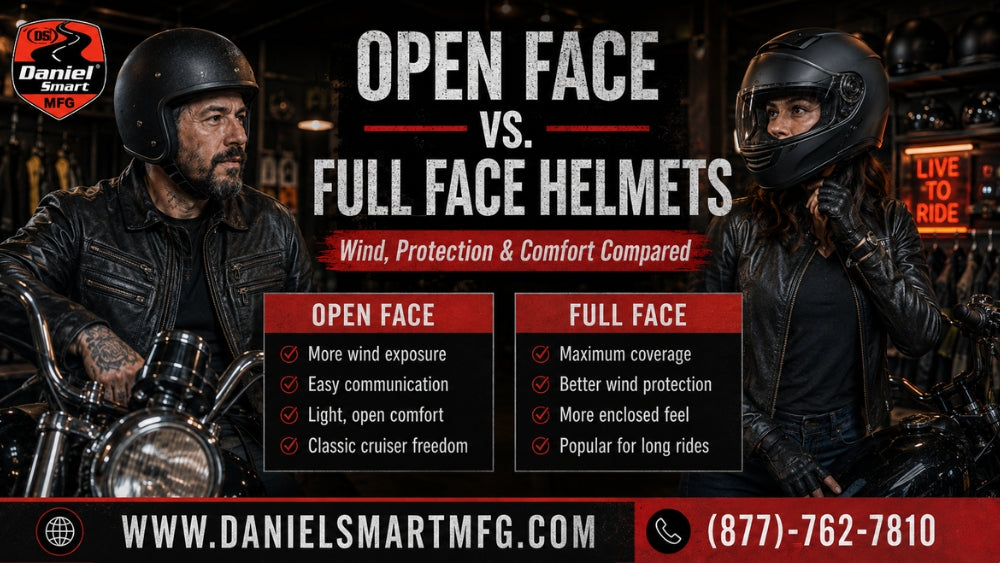
Here is where open-face helmets win hands down at low speeds and lose badly at highway speeds.
-
At speeds under 35-40 mph, an open-face helmet allows in a nice amount of airflow and keeps your peripheral vision and hearing nearly unimpeded.
-
The wind noise at the ears of the open-face helmet routinely exceeds 85 decibels above highway speeds, which is a level at which continued exposure causes hearing damage over time. Commuters and tourers who wear an open-face helmet should consider earplugs mandatory gear, not an accessory.
-
Full-face helmets are built around aerodynamic shells and tight-fitting neck rolls designed to cut down on wind noise and buffeting at highway speeds.
-
Full-face motorcycle helmets run hotter in stop-and-go traffic and summer heat, with airflow limited to vents rather than the open face.
Comfort and Visibility
This is where open-face helmets offer more freedom, while full-face helmets provide a more enclosed riding experience.
-
Open face helmets are lighter – which matters on long rides where neck fatigue builds up.
-
If your shield frame is out of your line of sight, you will actually see more out of the corner of your eye, a big plus for city riding and for states that allow lane splitting.
-
Full-face helmets fog more easily in cold or wet weather without a Pinlock insert. Taking one on and off is slower.
-
Another reason open-face helmets are still popular with casual riders and short-distance riders is that it is easier to communicate with a passenger or another rider at a stop when your face is exposed.
Open Face vs Full-Face Helmet Safety: What's Actually Different
Let’s start with what’s the same: when they’re DOT-certified motorcycle helmets, they meet the same federal standards for impact, penetration, and retention (FMVSS 218) in the areas they cover - the crown, sides, and back of your skull.
So, a certified open face helmet isn’t just a lesser version of a full face helmet in the areas it does cover; it’s simply designed to protect less of your head. The key difference really comes down to one specific part of your anatomy: the chin and jaw.
A full face helmet comes with a sturdy chin bar integrated into its shell, and that chin bar is part of what gets load-tested under DOT, ECE 22.06, and Snell certifications.
On the other hand, an open face helmet lacks a chin bar entirely, meaning there’s nothing standing between your jaw and the pavement in the event of a frontal impact. This is a fundamental aspect of the design, not a reflection of quality or brand.
Matching the Helmet to the Ride
Want to match the choice with your riding style? Here is what you need to know:
-
Best Helmet for Cruiser Riders:
Cruiser and touring-cruiser riders tend to be pretty evenly divided when it comes to helmet choices. Some love the classic look and open feel of half-shell helmets, especially when cruising at lower speeds, while others go for full face or modular helmets for those longer highway journeys.
If your rides mostly stay under 45 mph on local roads, a DOT-certified 3/4 shell motorcycle helmet is a reasonable pick. However, if you’re hitting the interstate, the wind noise and chin exposure make a full face or modular helmet the more sensible choice.
The good news is that many cruiser-specific full face and modular helmets now come in low-profile designs that fit right in with cruiser aesthetics rather than the sportbike style.
-
Sport, Commuter, and Touring Riders:
A full face helmet is the standard recommendation for a reason. At higher speeds, impacts carry more energy, and that chin bar is essential when things go sideways in a hurry.
-
Anyone Who Wants Both:
With a certified modular helmet, you get the freedom of an open face when you're parked, plus the safety of full face coverage when you're riding. Just be aware that this versatility often means you'll pay a bit more than you would for a regular fixed-chin full-face helmet.
Bottom Line: Are Full-Face Helmets Safer than Open Face Helmets?
For skull protection, both styles of certified helmets offer comparable safety for the areas they cover.
However, when we zoom in on the face, jaw, and chin, a full-face helmet is the clear winner in terms of safety. It’s the only design that provides structural coverage for that area.
Unfortunately, neither the NHTSA nor the Insurance Institute for Highway Safety has published a direct comparison of crash outcomes between open-face and full-face helmets.
So, think of the chin-bar gap as an engineering and design detail rather than a specific statistic; it's a fact that holds true no matter who’s analyzing it.
When choosing between DOT vs. Non-Certified Helmets, certification should always be one of the first things you check, regardless of the helmet style or price.
Daniel Smart MFG offers motorcycle helmet options for riders looking to balance coverage, riding style, and certified protection.
Ultimately, the right helmet depends on how and where you ride. Choose a properly fitted, certified helmet that provides the level of coverage you're comfortable with.
FAQs
-
Is a full-face helmet safer than an open-face helmet?
A full-face helmet generally provides more overall coverage because it protects the chin and jaw in addition to the areas covered by an open-face helmet. Both can provide certified protection for the areas they are designed to cover.
-
Are open-face helmets good for highway riding?
Open-face helmets provide less facial coverage and can expose riders to more wind, noise, weather, and road debris at higher speeds. Riders who regularly travel on highways may prefer the additional coverage of a full-face or modular helmet.
-
Does a DOT-certified helmet provide better protection than a non-certified helmet?
A helmet that meets the applicable DOT standard has been designed and tested to meet the requirements of FMVSS 218, while a non-certified helmet does not provide that same assurance of compliance. Always verify the certification markings and manufacturer information before buying.