


Whether you choose a $45 half helmet or a $250 full-face helmet, you can find a DOT sticker on both. But you must ask: Are cheap motorcycle helmets safe? And does an expensive one justify the value for money?
This is now confusing for bikers buying their lid for the first time.
Previously, we compared German helmet vs. half helmet coverage and looked at what separates DOT-certified helmets from non-certified helmets.
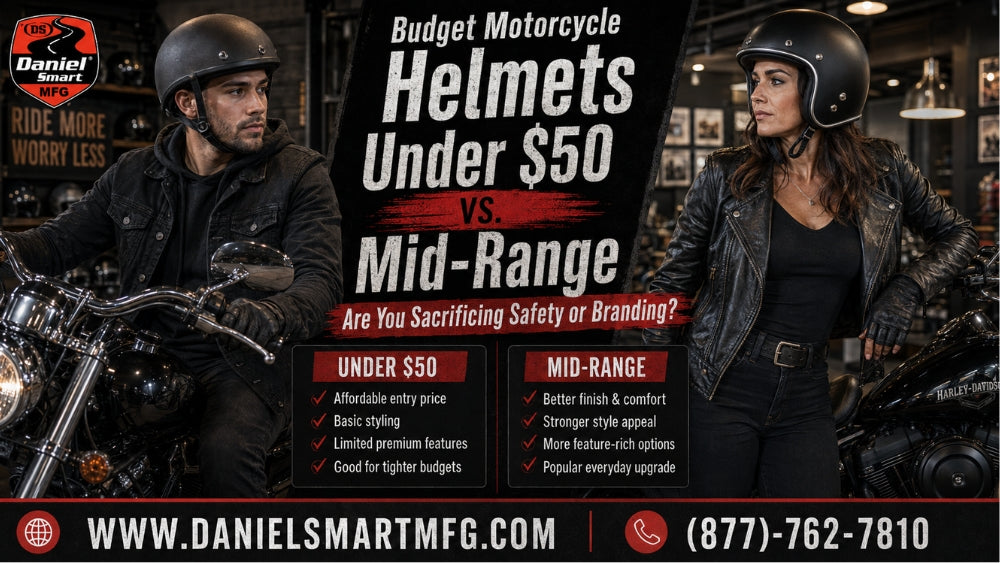
Today, we’re taking a closer look at another question riders often have before buying: Budget Motorcycle Helmets Under $50. Are you really giving up safety when you spend less, or are you simply paying more for branding and additional features?
Let us explain what is worth it before you spend a penny on it.
Motorcycle Helmet Coverage Levels: Under $50 is Better or Mid-range?
As for the under $50 helmets, you are mostly going to find novelty helmets. If you want "cheapest lid that looks cool at a stoplight", these will do; if you want "budget helmet that still gives you real crash protection", they won't.
Most of the "badass" and novelty lines are well above $50 when you get into DOT-approved models. However, their entry novelty half shells (like the H4 and various Eagle graphics) are listed in the high-$40s to low-$60s, before discounts.
For example, the H4 “Novelty Eagle Matte Black” is advertised as a non‑DOT novelty helmet and costs about $59.99. Other comparable Eagle graphic novelty helmets will generally be in this same price range.
Safety Reality Check: Novelty vs. Budget DOT
Yes, a DOT half helmet is still “safe” in the limited sense that it meets a minimum standard for impacts to the top of the head; it offers no chin or face protection and uses basic materials.
Novelty helmets take this a step further. They are sold as “Non-DOT” and “novelty use only,” which is the industry’s way of saying “don’t count on this for crash protection.”
What you get (and don’t get) when comparing an above-$50 DOT half helmet to a helmet under $50 is:
Certification:
-
Budget DOT Half Helmet: Passed FMVSS 218 testing (in theory at least).
-
Daniel Smart Novelty (H4, Eagle Graphics): Not DOT-specified; not FMVSS 218-tested.
Construction Focus:
-
Budget DOT: Shell & EPS minimal but impact/retention tested.
-
Novelty: Graphics, leather covers and low-profile “skull cap” looks are the focus; safety performance is not the design driver.
Are Motorcycle Helmets Under $50 Safe?
Yes. You can find a DOT-certified half helmet or a 3/4 shell from reputable brands like Bell, HJC, TCMT, or Daytona for around $50 to $60 that meets the FMVSS 218 standards.
However, keep in mind that at that price point, you’re not really getting anything beyond the bare minimum.
Also, the DOT label on the box doesn’t guarantee full coverage; since the standard doesn’t mandate a chin bar, a $45 open-face helmet that passes DOT certification doesn’t really tell you much about face protection, as it’s not required to provide any.
So, when you think of cheap vs mid-range motorcycle helmets, know that helmets under $50, the real concern isn't just about getting certified; it's about the shell itself.
National highway safety data highlights why this is so crucial: helmets are shown to be about 37% effective in preventing deaths for riders and 41% for passengers.
They also reduce the risk of brain injuries. This level of protection comes from a helmet's ability to absorb a single hard impact, rather than withstand multiple hits.
Unfortunately, cheaper helmets often use thinner and less consistent EPS foam liners, and the quality of the retention systems, like the straps and buckles, tends to be lower. Even if a helmet passes a lab test, it might not perform reliably throughout an entire production run if the manufacturer is cutting corners to keep costs down.
Is a Mid-range Helmet Worth the Extra Money?
Yes. And here’s what that extra $100-$200 really gets you:
-
Higher-quality EPS foam designed to handle a broader range of impact speeds, not just the bare minimum required for testing.
-
A shell made from fiberglass composite or polycarbonate blends instead of the standard ABS plastic, which helps distribute impact forces more evenly.
-
Improved ventilation systems, which can make a big difference during those long rides in the sweltering US summer heat.
-
A wider selection of shell sizes, ensuring the foam fits your head shape perfectly rather than relying on thick padding to fill in the gaps.
-
Optional Snell or ECE 22.06 certification in addition to DOT, meaning it’s been tested to a higher standard.
Fit is just as important as everything else. A $50 helmet that fits snugly on your head will offer better protection than a $300 helmet that’s too loose. Besides, the best helmet for cruiser riders is the ones that provide complete protection.
And the foam needs to make even contact with your skull to do its job properly. So, whenever possible, try on helmets in person, no matter the price tag.
Where the Value Curve Starts to Flatten
Once you go past about $400-$600, you're mostly paying for:
-
Exotic Ultra Light Shell (Premium Composites, Full Carbon)
-
Minor aero and noise changes
-
Racing pedigree & brand prestige
If you’re a daily commuter or weekend rider who’s riding less than 3,000 miles a year, a helmet in the $200–$350 range that fits well will usually offer the best balance of protection, comfort, and durability.
How to Think about it as a Rider
If you are debating between $50 vs. mid range:
-
$45-$80 budget DOT half/3/4: Acceptable minimum protection, heavier, noisier, basic foam and liner, shorter comfortable life.
-
$200-$350 mid-range full-face or modular: more durable shell, better foam, quieter, cooler, more fit options, often higher or additional certifications.
Conclusion
When shopping for the best affordable motorcycle helmets, price should never be the only deciding factor. A helmet under $50 may meet basic requirements, but riders should also consider certification, fit, construction, coverage, and comfort.
Half-shell helmets can suit riders who prioritize an open, lightweight design, while modular helmets offer greater coverage and versatility for everyday riding.
At Daniel Smart MFG, the goal is to help riders find helmets that balance protection, comfort, and riding style without paying simply for a premium label.
Whatever your budget, choose a properly certified helmet that fits securely and provides the level of coverage your riding demands.
FAQs
Is a half-shell helmet safer than a modular helmet?
A modular helmet generally provides more coverage because it can protect the head, face, and chin when closed. A half-shell helmet leaves much of the face and lower head exposed, so the two offer different levels of protection.
What should I look for when buying a budget motorcycle helmet?
Check the helmet’s certification, fit, shell construction, retention system, coverage, liner quality, and overall condition. Avoid choosing based on price or appearance alone.
How long does a motorcycle helmet typically last?
A motorcycle helmet should generally be replaced after a significant impact or when the manufacturer’s recommended service life has been reached. Age, regular use, heat, sweat, and wear can also affect the helmet’s materials over time.