


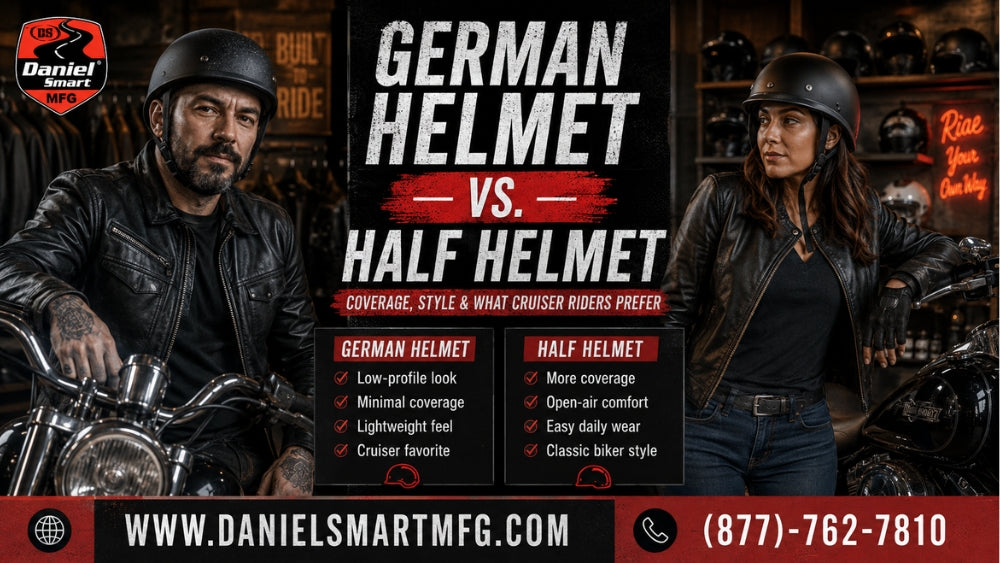
While shopping for motorcycle helmets, you might have seen 2 shelves with almost identical options: German-style helmets and standard half helmets. Both are great choices and popular among cruiser riders. Both are lightweight and convenient for many. But differences occur when you are trying to balance legal protection with a sleek biker look.
Previously, we compared Daytona Helmets vs. LS2 Helmets vs. Badass Helmets and explored the difference between half helmets and 3/4 helmets, helping riders understand their options based on coverage, style, and protection.
Today, we’ll take a closer look at German helmets vs. half helmets and explain how they differ in coverage, design, certification, and overall suitability for cruiser riders.
So, how can we differentiate between a German Helmet vs. Half Helmet coverage?
Let us break it down in this article.
What is a German Helmet?
"German helmet" is a shape of helmet, not a certification level. The style is derived from the German military helmets of the WWII era - rounded, basic, fits tight to the skull with little to no brim or visor. American helmet brands embraced the look decades ago and now offer it as a half-helmet variant often referred to as a "brain bucket," "beanie," or "skull cap" helmet.
What riders forget is that a German-style shape can be built in two quite different ways.
-
DOT-certified motorcycle helmets or German helmets feature a thick layer of EPS (expanded polystyrene) foam, usually at least an inch thick, inside a hard outer shell. All street-legal helmets must pass a standard called Federal Motor Vehicle Safety Standard 218 (FMVSS 218), which these meet.
-
Novelty German helmets are shaped the same but don't have safety liners. Some have a bogus or unearned DOT sticker. They can be legally purchased. But they are illegal and unsafe to ride on public roads in states with helmet laws.
There is a subtle visual difference. The functional difference is nil. NHTSA testing has shown helmets with fraudulent DOT labels fail almost all of the actual safety requirements of the standard.
What is a Half Helmet?
German helmets fall under the broader category of a half helmet. It covers the top and back of the skull down to around ear level, leaving the face, jaw, and neck completely exposed. No chin bar, no visor for the most part, sometimes a small brim.
A generic half helmet versus a German helmet:
-
Often has a slightly larger, rounder shell shape (sometimes called the “mushroom head” look)
-
May have a small snap-on visor or shield mount
-
More variation in shell material and liner thickness. Can be made by a wider variety of manufacturers
Both cruiser motorcycle helmet styles sacrifice coverage for airflow, light weight, and an open, old-school riding feel, which is exactly what draws cruiser riders.
German Helmet vs. Half Helmet: Coverage Level
Motorcycle helmet coverage levels can be categorized into four main coverage tiers. Understanding where each type fits in helps clarify that the difference between German and half helmets isn't really about safety levels; it's more about style within the same category.
-
Full-face Helmet: Offers complete coverage for the skull, face, jaw, and chin. They provide the highest level of protection but come with the trade-off of minimal airflow, so you won't get that wind-in-your-hair feeling.
-
Modular Helmets: Feature a full-face design with a chin bar that flips up. This gives riders the best of both worlds: full protection on the highway and the convenience of an open face when you come to a stop.
-
3/4 shell Helmet (open-face): Also known as an open-face helmet, covers the skull and ears while leaving the face exposed. It sits above the ears, unlike a half helmet, and some riders like to add a snap-on visor for extra protection.
-
Half-shell / German Helmet: Half-shell, or German, helmets offer the least coverage of any DOT-legal option, protecting only the top of the skull.
When comparing a German helmet to a half helmet, you're really looking at the smallest coverage tier. However, comparing a German helmet to a 3/4 helmet shows a more significant difference; the 3/4 shell motorcycle helmet provides coverage for the ears and lower skull, which a German or standard half helmet does not.
Why Cruiser Riders Lean Toward These Two Styles
Cruiser culture is all about style and vibe, often putting those ahead of track-level safety, and you can really see that in the choice of helmets:
-
Low profile is key. A sleek, rounded German helmet fits the classic curves of a cruiser or chopper way better than a bulkier full-face option.
-
Airflow and visibility are crucial. Riders who enjoy leisurely, open-road cruising appreciate the breeze and clear sightlines that a half helmet provides.
-
Weight is a factor too. Many DOT-certified half helmets come in at under 2 pounds, which is a big deal for those long rides.
It's about meeting the legal minimum, not the maximum. In states with universal helmet laws—17 states plus D.C. by 2026- a DOT-certified half or German helmet checks the box without sacrificing style.
DOT vs. Non-certified Helmets: How to Actually Check
In the U.S., DOT certification operates on a self-certification basis, meaning that manufacturers are responsible for testing their own helmets to ensure they meet FMVSS 218 standards and then applying the DOT label themselves.
The NHTSA doesn’t pre-approve helmets before they hit the market, which is a big reason why you might find counterfeit DOT stickers on unsafe novelty helmets.
So, before you decide to buy a German or half helmet, make sure to check for:
-
Look for a permanent DOT label on the back of the helmet shell, along with a separate interior tag that shows FMVSS 218, the model, and the size.
-
When it comes to weight, DOT-compliant helmets typically weigh around 3 pounds. If you find a helmet that weighs less than 1 pound, it’s likely not meeting the necessary standards.
-
You should also be able to feel a firm inner liner through the padding, rather than just soft foam.
-
Make sure there’s a manufacturer name and model number on it, not just some generic sticker.
If a helmet doesn’t have all these features, consider the DOT mark more of a decoration than a badge of honor.
Conclusion
Choosing between a German helmet and a half helmet ultimately comes down to coverage, comfort, style, and your riding needs. Both offer the lightweight, open feel that many cruiser riders appreciate, but neither provides the facial and jaw coverage of a 3/4 or full-face helmet.
Always check for genuine DOT certification and make sure the helmet fits securely before riding. For riders searching for the best helmet for cruiser riders, choosing a properly certified helmet that matches your preferred style is essential.
Daniel Smart MFG offers motorcycle helmet options designed to combine classic cruiser aesthetics with practical protection, helping riders find a style that suits their journey.
FAQs
1. Is a German helmet the same as a half helmet?
German helmets are a style of half helmet, so they provide similar minimal coverage. The main difference is their distinctive low-profile, military-inspired appearance.
2. Are German-style and half helmets safe for cruiser riding?
DOT-certified German-style and half helmets meet applicable U.S. safety requirements, but they provide less coverage than 3/4 or full-face helmets. Riders should choose based on their desired protection level.
3. What should I look for when buying a cruiser motorcycle helmet?
Look for genuine DOT certification, a secure fit, adequate impact-absorbing liner, comfortable sizing, and construction suited to your riding style. Always verify the helmet’s certification before purchasing.