


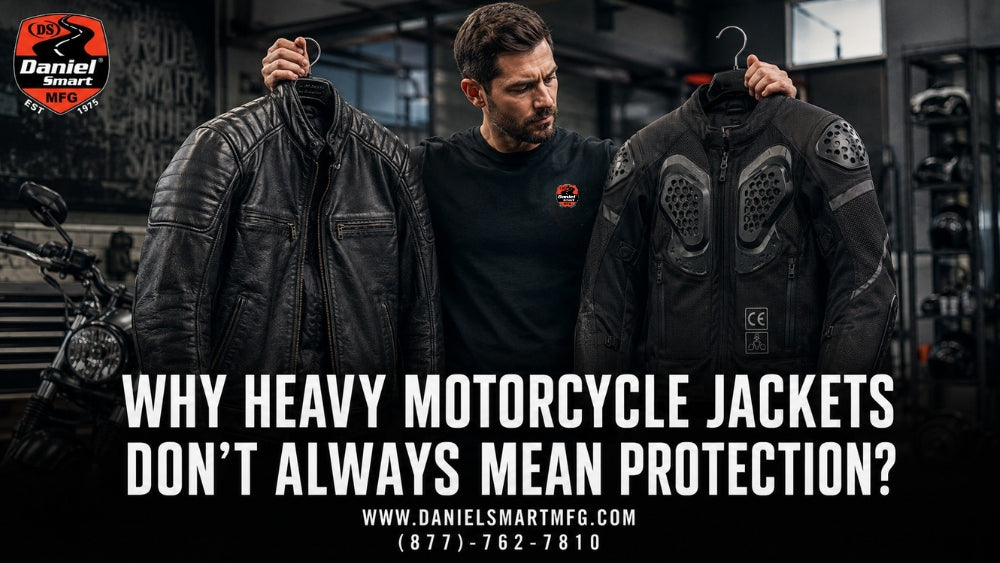
A lot of riders who have just joined the club or started riding motorcycles go into the showroom, judge the jacket by weight, and are done with shopping. However, many riders don't realize that just because a jacket has a certain weight doesn't guarantee protection.
Yes, they are stiff in the shoulders, heavy on the sides, and make everyone think they can withstand a crash. The reality is that weight tells you nothing about a jacket's performance in a crash. What matters at that time is the armor inside. These heavy jackets can offer some protection, but if the impact is severe, there is no guarantee.
Understand the Weight-Equals-Safety Myth
Riders like this shortcut because it makes sense. A heavy leather hide appears to be more durable than a light textile shell. A six-pound jacket seems like it has to be working harder than a three-pound jacket. Neither is necessarily the case.
Motorcycle jacket weight vs protection really is a matter of material science, not weight. A jacket can be heavy due to:
-
Thinner high-grade leather, or thicker low-grade leather, which has low tensile strength.
-
Inexpensive padding or foam that adds bulk but does not absorb impact energy properly.
-
Extra zippers, buckles, and hardware that are purely decorative.
-
Stacked up with liners and insulation for warmth, not crashworthiness.
None of those add-ons improves a jacket's performance during a slide or a direct hit. A rider can own one of the heaviest motorcycle jackets on the market and still be under-protected in the two places that matter most: abrasion resistance and impact absorption at the shoulders, elbows, and back.
What Actually Protects You in a Crash
A motorcycle jacket protects you in a crash in two separate ways, and a jacket needs both to do its job.
The outer material's resistance to abrasion determines how long it will hold up against asphalt. Good leather or a good weave on a textile can give a rider a few seconds of slide time before the fabric burns through. A few seconds may not sound like much, but it can be the difference between road rash and exposed muscle or bone.
The shell doesn’t absorb the impact; the armor does. CE motorcycle jackets are certified for protection.
They have foam or plastic inserts in the shoulders, elbows, and sometimes the back, and are rated according to the European standard EN 1621-1 for limb protectors and EN 1621-2 for back protectors.
These inserts are rated Level 1 or Level 2, the latter being capable of absorbing more force. A jacket without rated armor relies on the thickness of the fabric alone to protect a joint from a direct hit, no matter how heavy it is. Fabric doesn’t do that job well.
Know the Types: Leather vs Textile
Leather motorcycle jackets are known for their toughness, and that reputation is well-deserved. High-quality leather offers fantastic abrasion resistance and gets better with age. For street riding, men's leather motorcycle jackets usually feature panels 1.0 to 1.3mm thick, providing sufficient protection during a slide without being overly bulky.
On the other hand, textile motorcycle jackets have made significant strides. Modern ballistic nylon and Cordura fabrics can match or even surpass lower-grade leather in abrasion tests, all while being lighter and more resistant to the elements. Besides, textile jackets often come with more options for armor pockets and adjustable venting, which is a big plus for riders in the hot climates of the South and Southwest.
However, it’s important to note that neither material guarantees protection on its own. A poorly made leather jacket and a subpar textile jacket can both fail in the same ways: seams can tear, armor can shift out of place, or there might not be any real armor at all.
Best Protective Motorcycle Jacket Features to Check Before Buying
Forget about the weight test for now. Instead, focus on these key points:
-
Look for CE-certified motorcycle jackets that meet EN 17092, the latest European standard for motorcycle protective gear. It’s rated in classes AAA, AA, A, B, and C, depending on factors such as abrasion resistance, seam strength, and impact protection.
-
Make sure the jacket has CE-rated armor in the shoulders and elbows, preferably Level 2, and either comes with a back protector or has a pocket for one.
-
Check for reinforced stitching, especially at the seams that will take the brunt of a slide.
-
Aim for a snug fit that allows for minimal movement, ensuring the armor stays in place over the joints during an impact.
-
Lastly, look for abrasion-resistant material in the areas most likely to make contact, even if the rest of the jacket is made of lighter fabric for better airflow.
A jacket that meets all these criteria typically weighs less than one that doesn't, as the protection comes from advanced materials and certified armor rather than just extra bulk.
Buying Smart in the US Market
These days, most major motorcycle gear retailers in the US make it easy to find CE ratings right on the product page, so you won’t have to dig too deep for this info. When you're on the hunt for a heavy motorcycle jacket, or any jacket for that matter, it's smart to prioritize the CE rating and armor specifications first, with the jacket's style or weight coming in a distant second.
You'll notice a wide range in prices: a certified textile jacket from a well-known brand typically falls between $95 and $350, while certified leather jackets from reputable manufacturers can range from $180 to $600.
Note: Prices can vary by vendor and across seasons and collections.
If you come across jackets priced significantly lower than that, be cautious; they often lack genuine CE-rated armor, no matter how hefty they might seem when you pick them up.
Conclusion
The weight of a motorcycle jacket should never be the deciding factor when it comes to rider safety. A quality motorcycle riding jacket protects through certified armor, durable abrasion-resistant materials, and strong construction, not unnecessary bulk.
Before making a purchase, always check for impact protection, CE ratings, and proper fit rather than assuming that a heavier jacket offers greater safety.
Investing in CE-certified motorcycle jackets for protection gives you confidence on every ride. Daniel Smart MFG offers premium motorcycle riding gear designed to combine comfort, style, and dependable protection. Our collection helps riders choose jackets that perform when safety matters the most.
FAQs
-
Does a heavier motorcycle jacket provide better protection?
No, jacket weight alone does not determine crash protection. Certified armor and abrasion-resistant materials play a much bigger role in rider safety.
-
What should I look for in a protective motorcycle jacket?
Choose a jacket with CE-rated armor, reinforced seams, and abrasion-resistant materials. A proper fit also helps keep protective armor in place during impacts.
-
Are CE-certified motorcycle jackets worth buying?
Yes, CE-certified motorcycle jackets meet recognized safety standards for impact and abrasion protection. They offer greater confidence and protection than non-certified alternatives.